
Why Rewriting Everything Is Usually the Wrong First Move
May 14, 2026
A full rewrite can feel like the cleanest answer to fragile software, messy workflows, or years of shortcuts. In practice, it often increases delivery risk before solving the real problem. A better first move is usually diagnosis, stabilization, and focused replacement.
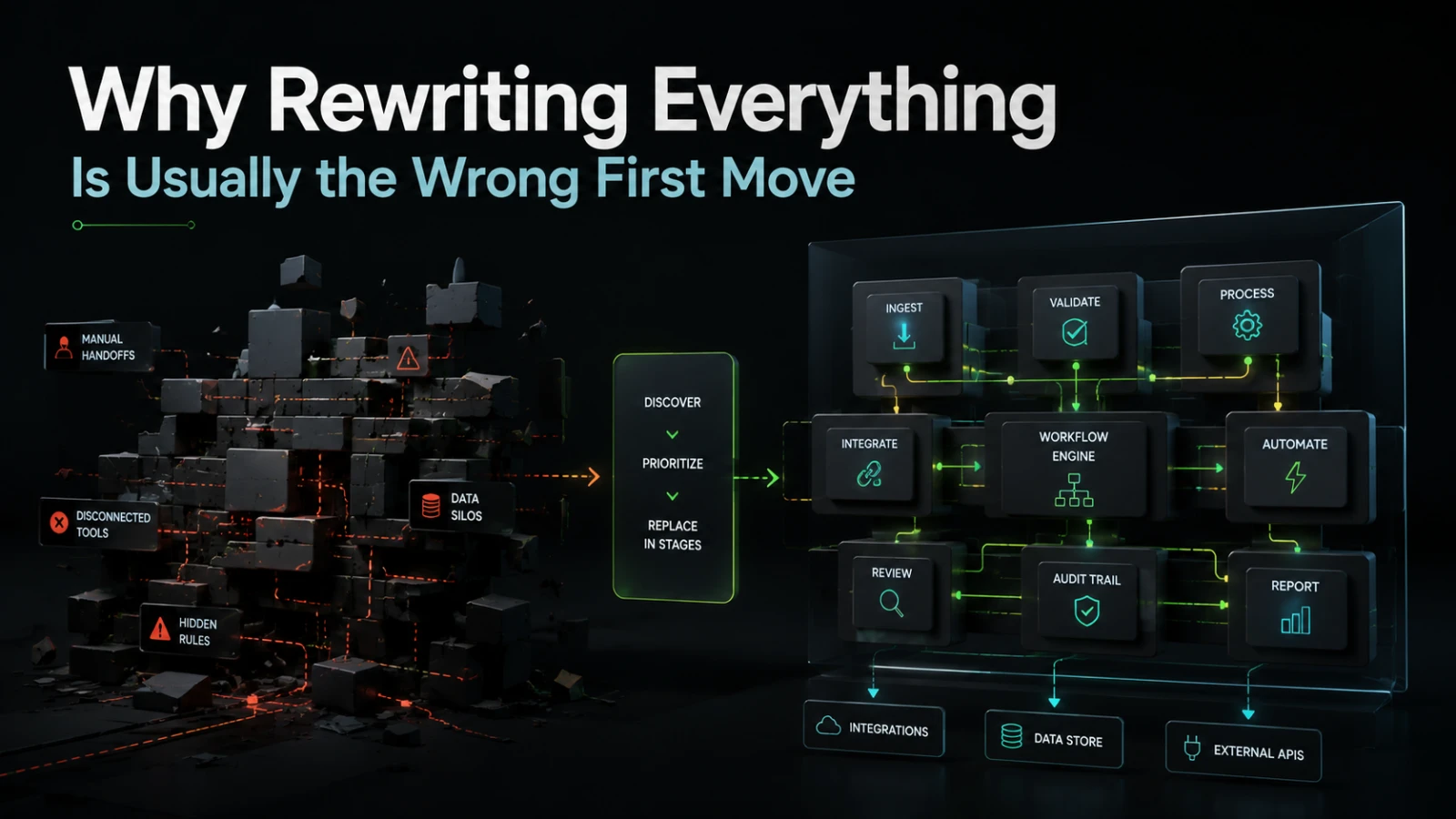
A full rewrite is tempting because it promises a clean start. No old decisions, no awkward workarounds, no hidden logic, no inherited complexity. For a founder, operator, product owner, or CTO dealing with fragile systems, that can sound like the only serious option.
But rewriting everything is usually the wrong first move. Not because legacy systems should never be replaced, but because most teams decide to rewrite before they fully understand what the existing system actually does, where the business risk sits, and which parts are truly worth rebuilding.
The better question is not, “Should we rewrite this?” It is, “What is the smallest dependable change that reduces operational risk and gives us a clearer path forward?”
The rewrite instinct is usually a symptom
Teams rarely ask for a rewrite because the code is old in isolation. They ask because something operational is painful.
Common triggers include:
Manual workarounds around the system
Repeated errors in approvals, billing, fulfillment, or reporting
Slow changes because nobody trusts the current architecture
Disconnected tools that require copying data between systems
Internal platforms that only one person understands
Features that break when a small change is made elsewhere
A product idea blocked by unclear technical foundations
These are real problems. The mistake is assuming they all require the same response.
A rewrite treats the visible system as the problem. Often, the deeper issue is workflow state, unclear ownership, weak integration boundaries, missing audit trails, inconsistent data, or years of business logic living in people’s heads instead of the software.
If those issues are not understood first, the rewrite can recreate the same problems in a newer stack.
Why full rewrites increase delivery risk
A rewrite creates two systems at once: the old system that still runs the business, and the new system that is not ready yet.
That means the team must maintain current operations while trying to rebuild existing behavior, interpret undocumented logic, migrate data, design new workflows, and avoid disrupting users. This usually increases coordination cost before it creates value.
The main risks are practical, not theoretical:
Hidden business rules: The existing system may contain years of decisions that were never documented.
Unclear feature parity: Teams underestimate how much the old system does until users notice missing details.
Data migration risk: Moving records is often easier than preserving meaning, history, status, ownership, and exceptions.
Operational disruption: Rewrites can change how teams work before the new process is ready.
Delayed feedback: Users may not touch the new system until too much has already been built.
Budget pressure: A rewrite can consume delivery capacity without improving day-to-day operations quickly.
The danger is not that the new system will fail completely. The more common problem is that it takes longer than expected, carries more scope than planned, and still leaves the business dependent on manual patches during the transition.
Rebuild, repair, or replace in stages?
A full rewrite is one option. It should be compared against less risky paths before becoming the plan.
Approach | Best fit | Main benefit | Main trade-off |
|---|---|---|---|
Stabilize the existing system | The current system is painful but still usable | Reduces immediate operational risk | Does not solve deeper architecture issues alone |
Replace one workflow | A specific process causes most errors or manual effort | Delivers visible improvement faster | Requires clear boundaries around that workflow |
Build a parallel internal tool | The old system lacks support for a new operational process | Avoids changing the core system too early | Can create another tool if ownership is unclear |
Extract one service or integration | A specific capability needs clearer ownership | Improves maintainability around a critical function | Requires careful integration design |
Full rewrite | The current platform blocks the business and cannot be safely evolved | Creates a cleaner long-term foundation | Highest discovery, migration, and adoption risk |
The right path depends on how the business operates, where the current system creates risk, and how much change users can absorb at once.
What teams should understand before deciding
A rewrite decision should be based on evidence, not frustration.
Before committing, teams should map a few concrete areas.
First, identify the workflows that matter most. For example: lead intake, quote approval, order processing, customer onboarding, scheduling, invoicing, support triage, compliance review, or reporting. The system may be ugly, but only a few workflows may be causing most of the rework.
Second, separate code problems from business process problems. A better codebase will not fix unclear approval rules, duplicate data entry, or inconsistent ownership. Those issues need process design as much as software delivery.
Third, inspect the data model. Many rewrite projects become difficult because the data contains exceptions that nobody planned for. Status fields, manually edited records, duplicated customer profiles, old pricing logic, and incomplete history can all affect the build.
Fourth, understand integration points. Internal systems rarely stand alone. They connect to CRMs, accounting tools, payment systems, spreadsheets, email, inventory platforms, customer portals, or reporting tools. A rewrite that ignores these connections will underestimate the real work.
Fifth, define what “better” means in operational terms. Cleaner code matters, but business stakeholders need outcomes they can inspect.
Better might mean:
Fewer manual handoffs
Clearer approval state
Easier audit trail
Lower rework after data entry
More predictable reporting
Faster onboarding for new team members
Safer changes to pricing, permissions, or workflow rules
Easier integration with existing tools
These are more useful than a vague goal like “modernize the platform.”
The first useful version is often not a rewrite
For many businesses, the strongest move is to build or improve the part of the system closest to operational pain.
That may be an internal tool that replaces a spreadsheet approval flow. It may be an automation that routes requests, validates data, and keeps a clear audit trail. It may be a small customer portal that reduces inbox work. It may be an integration layer that stops teams from copying data across tools.
This approach has a few advantages.
It gives users something practical earlier. It tests assumptions before the whole platform is redesigned. It shows where the existing system can be extended and where it truly resists change. It also creates a cleaner business case for any deeper rebuild.
For example, a company may think it needs a new operations platform because fulfillment is slow. After discovery, the real issue may be that orders arrive from three channels, each with different fields, and the team manually reconciles missing data before work can begin.
In that case, rewriting the whole platform may not be the first move. A better first step could be a controlled intake workflow that normalizes order data, flags exceptions, and gives the team one queue to manage. The business gets lower manual effort and clearer workflow state without waiting for a complete replacement.
When a rewrite is justified
There are cases where a rewrite is the right path. The key is that the decision should follow diagnosis.
A rewrite may be justified when:
The current system cannot support required business workflows without unsafe workarounds
The architecture prevents essential integrations
Maintenance depends on fragile knowledge held by one person or vendor
Security, permissions, or auditability cannot be improved within the current structure
The data model is fundamentally misaligned with how the business now operates
Every meaningful change creates excessive regression risk
The cost of staged improvement is higher than controlled replacement
Even then, “rewrite everything” should usually become “replace deliberately.”
That means choosing boundaries, defining migration phases, deciding which workflows move first, and keeping the old system running only where it still serves a purpose.
A safer way to approach modernization
A dependable modernization plan usually starts with discovery, not coding.
The practical sequence is:
Map the current workflow and identify where work slows down or breaks.
Identify the systems, people, approvals, and data involved.
Separate must-have behavior from inherited behavior.
Define the first useful version that reduces real operational pain.
Decide what can be repaired, wrapped, automated, integrated, or replaced.
Build in a way that makes future replacement easier, even if the first step is small.
This gives the team a path that is easier to reason about in production. It also reduces the risk of spending months recreating features that do not matter, while missing the workflow issues that do.
The commercial point: reduce risk before increasing scope
A rewrite is not just a technical decision. It is a commercial decision about risk, timing, attention, and operational continuity.
For founders, a full rewrite can delay validation of the next product move. For operators, it can create months of uncertainty while manual work continues. For CTOs and technical leads, it can absorb team capacity before the architecture has been properly scoped. For business owners, it can turn a painful system into a large delivery commitment without enough confidence.
The more practical first move is to reduce uncertainty.
That might mean auditing the workflow, stabilizing a risky integration, building a focused internal tool, replacing one process, or designing a phased migration. These steps are not as emotionally satisfying as declaring a fresh start, but they usually create better information and lower delivery risk.
If your team is deciding whether to automate a repeated process, replace a fragile internal tool, or rebuild part of a business-critical system, Aptenova can help frame the workflow, risk, and first practical build.
Conclusion
Rewriting everything can be necessary, but it should rarely be the first move.
The first move should be understanding what the system does, where the operation is exposed, which workflows create the most manual effort, and what kind of change will create value without unnecessary disruption.
A clean rebuild sounds efficient when the current system feels messy. In practice, dependable software improvement usually starts smaller: clarify the workflow, reduce the risk, improve the boundary, then replace what genuinely needs to be replaced.
Put it into practice
Working through a similar problem?
Tell us about your product and the change you need. We can discuss a focused feature, a new integration, an AI workflow or a first release.