
Why Founder-Led Products Need Technical Product Judgment Early
May 13, 2026
Founder-led products often start with strong market insight, but early technical product judgment determines whether the first build becomes usable software or expensive rework. This article explains where judgment matters, what usually goes wrong, and how to scope a dependable first version.
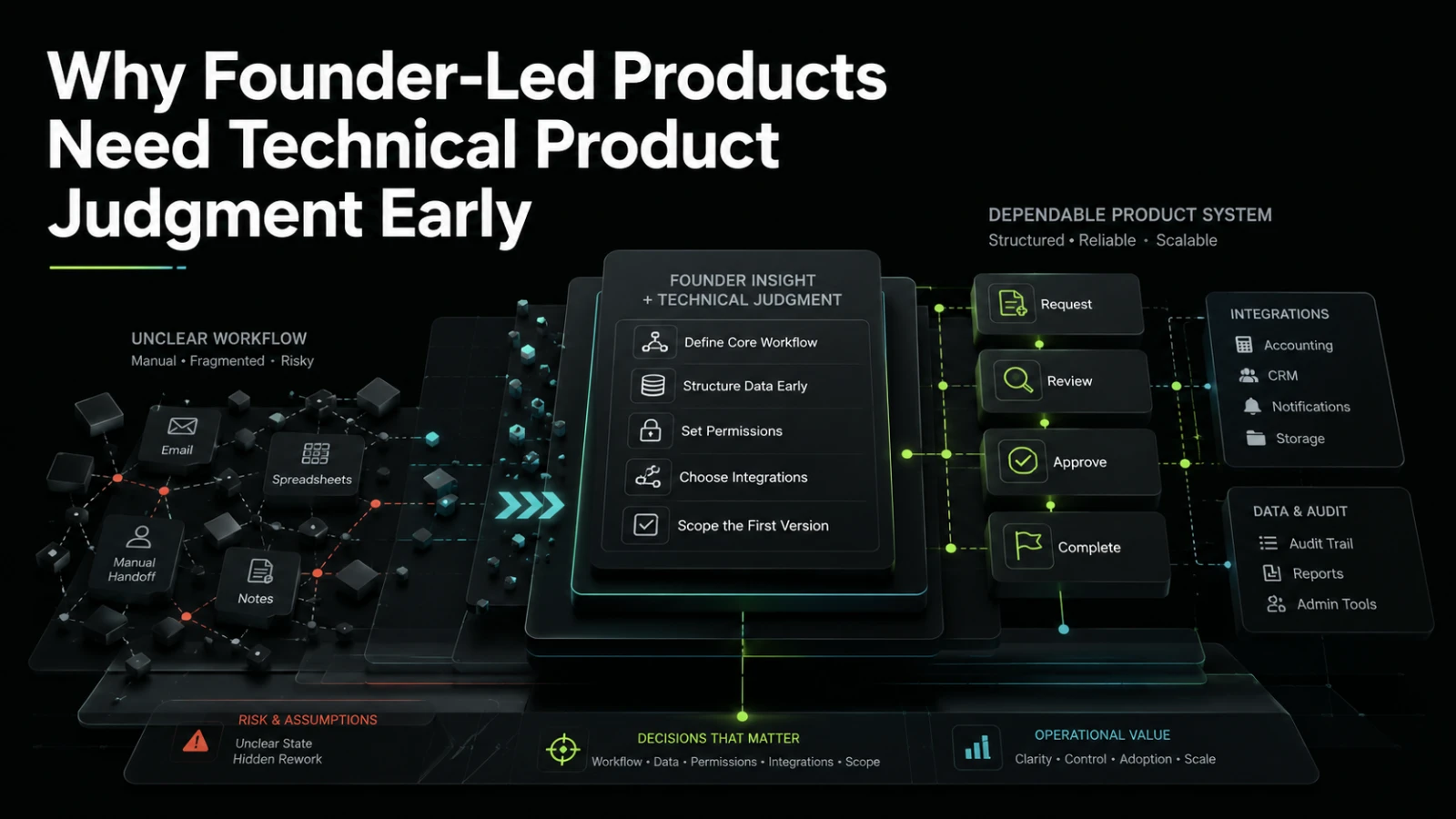
Founder-led products often begin with a real advantage: the founder understands the problem before anyone else does. They have seen the repeated manual work, the broken handoffs, the spreadsheet nobody trusts, or the customer workflow that existing tools do not quite support.
That insight matters. But it is not the same as technical product judgment. Early decisions about workflow state, permissions, integrations, data structure, reporting, and version-one scope can determine whether the product becomes a useful operating system for the business or a fragile interface wrapped around unclear assumptions.
Founder insight is not the same as product architecture
A founder usually knows what should change. They can explain the pain, the commercial opportunity, and the user frustration. The difficult part is translating that into software decisions that will still make sense after the first few users, edge cases, and operational exceptions appear.
Technical product judgment sits between business intent and implementation. It asks questions such as:
What is the smallest version that creates operational value?
Which workflow steps need to be enforced by software?
Which decisions should remain manual at first?
What data needs to be structured from day one?
Which integrations are necessary now, and which can wait?
What will make this system easy to maintain after launch?
Where can shortcuts create hidden delivery risk?
Without this judgment, teams often build too much interface and too little product logic. The screens may look convincing, but the system does not reliably manage ownership, workflow status, exceptions, auditability, or integration boundaries.
What usually goes wrong when judgment comes too late
Founder-led products can move quickly, which is a strength. The risk is that speed becomes a substitute for decision quality.
A rushed first build often turns uncertain product decisions into code before the team has clarified the workflow. This creates systems that are hard to change because the wrong assumptions have already been embedded into the database, user roles, approval paths, and integration logic.
Common early mistakes include:
Treating a prototype as if it were a production system
Building screens before defining workflow states
Automating a broken manual process without simplifying it
Adding integrations before the source of truth is clear
Ignoring permissions until different user groups appear
Storing important business data in unstructured notes
Designing for an ideal path while real operations need exceptions
Underestimating admin tools, error handling, and support visibility
These are not only engineering issues. They affect cost, adoption, customer trust, operational control, and future delivery speed.
A product can look almost finished while still being difficult to operate. That is why early technical product judgment matters.
The first version should prove workflow value, not feature volume
A founder may feel pressure to build the complete product vision immediately. Investors, customers, partners, and internal teams may all ask for different features. The result can be a version-one scope that is too wide, too expensive, and too hard to validate.
A better first version proves that the core workflow can run dependably.
That means the product should help users complete a meaningful job with less confusion, fewer manual handoffs, and clearer state. It does not need every future feature. It does need enough structure to show whether the product can become a real operating layer rather than a polished demo.
For example, an internal approval tool does not need advanced analytics on day one. It does need clear request ownership, approval status, permission rules, change history, and notifications that do not create noise.
A B2B client portal may not need every dashboard view immediately. It does need dependable authentication, clean data boundaries, clear document or task status, and a way for teams to see what requires action.
A workflow automation product may not need a long list of integrations at launch. It does need a clear source of truth, predictable failure handling, and visibility when automated steps do not complete.
Founder-led product decisions that need technical judgment
The most expensive product mistakes are often made before development feels complex. They happen during scoping, when decisions seem small.
Decision area | Weak early choice | Better early judgment | Why it matters |
|---|---|---|---|
Workflow state | Treating work as a simple to-do list | Defining statuses, ownership, transitions, and exceptions | Makes the system easier to reason about in production |
Data model | Storing key information as free text | Structuring important business data from the start | Improves reporting, automation, and integration options |
Permissions | Giving everyone similar access | Mapping user groups, roles, and sensitive actions | Reduces operational and security risk |
Integrations | Connecting every tool immediately | Starting with the systems that define the source of truth | Lowers integration risk and avoids duplicated data |
Admin visibility | Focusing only on end-user screens | Including internal views for support, review, and correction | Makes the product easier to operate after launch |
Scope | Building the full vision | Building the smallest dependable workflow | Reduces rework and improves learning speed |
The goal is not to slow the founder down. The goal is to make speed safer by choosing what deserves structure early and what can remain flexible.
The hidden cost of “we will fix it later”
Some shortcuts are reasonable. A founder-led product should not be over-engineered before there is evidence that the workflow matters. But not all shortcuts are equal.
A rough visual design can be improved later. A missing reporting screen can be added later. A simple notification system can often be refined later.
Other choices are harder to unwind:
A poor data model
Unclear workflow ownership
Missing audit history for important actions
No separation between customer accounts
Business rules scattered across manual admin work
Integrations built without error handling
Hard-coded assumptions about pricing, roles, or approval paths
These decisions can increase maintenance effort and make future changes slower. They may also create operational risk if users depend on the system for customer delivery, finance, compliance support, or internal coordination.
Technical product judgment helps decide which shortcuts are acceptable and which ones create debt that will be expensive to repay.
Generic tools can validate demand, but they rarely define the product
Many founder-led products begin with spreadsheets, forms, shared inboxes, no-code tools, or generic SaaS platforms. That is often a sensible starting point. These tools can help prove that a workflow exists and that users care enough to repeat it.
The problem begins when the temporary workflow becomes the product strategy.
Generic tools often struggle when the business needs specific workflow state, permissions, customer-specific logic, integration rules, or auditability. They can also create scattered ownership, with important data split across spreadsheets, email threads, and manual approvals.
The decision is not “generic tool or custom software” in abstract terms. The better question is: where is the business losing control?
Approach | Best fit | Main limitation | Signal that custom software may be needed |
|---|---|---|---|
Spreadsheet | Early exploration, small team tracking, flexible data capture | Weak workflow control and limited audit trail | People disagree about the current status or source of truth |
Shared inbox | Simple request handling and customer communication | Poor structured data and ownership visibility | Work is missed, duplicated, or hard to report on |
Generic SaaS | Standard processes with limited customization needs | Product logic must fit the tool’s model | Teams maintain workarounds outside the system |
Custom internal tool or platform | Specific workflows, integrations, permissions, and operating rules | Requires clear ownership and maintenance planning | Manual coordination is becoming a delivery bottleneck |
A founder-led product does not need to abandon simple tools too early. But it should recognize when those tools stop clarifying the workflow and start hiding complexity.
What to define before development starts
A good technical product discussion should make the first build clearer, smaller, and more dependable. Before development starts, founder-led teams should define a few practical things.
First, define the core job. What must the user complete, and what does a successful outcome look like?
Second, define workflow state. What stages can work move through? Who owns each stage? What happens when something is rejected, delayed, expired, duplicated, or incomplete?
Third, define the source of truth. Which system or data set should be trusted when information conflicts?
Fourth, define user roles. Who can view, create, edit, approve, export, delete, or override?
Fifth, define the minimum useful admin view. After launch, someone will need to understand what happened, fix mistakes, and support users.
Sixth, define what not to automate yet. Some decisions need human review until patterns are clearer.
This level of definition does not require a huge specification document. It does require enough clarity to prevent the build from becoming a collection of assumptions.
Technical product judgment also protects commercial focus
Founders often think technical judgment is mainly about engineering quality. It is also about commercial focus.
A technically sensible first version helps answer business questions faster:
Will users adopt this workflow?
Does the product reduce repeated manual work?
Can the team operate it without constant developer support?
Are the most important exceptions visible?
Is the data useful enough for reporting or future automation?
Can the product support the next customer or team without a rebuild?
When the first version is scoped around these questions, the product becomes easier to evaluate. The founder can see what to improve, what to remove, and what deserves more investment.
Without that structure, feedback can become vague. Users may say the product is confusing, incomplete, or slow, but the team cannot easily tell whether the problem is UX, workflow logic, missing data, unclear ownership, or poor operational fit.
When to involve a technical product partner
The right time to bring in technical product judgment is before the build becomes expensive to change. That does not mean the idea must be fully defined. In many cases, the value of an early technical partner is to help shape the first useful version.
This is especially relevant when:
The product depends on workflow automation
Several systems need to exchange data
The team is replacing spreadsheets or inbox-based operations
Different user roles need different permissions
The founder knows the business problem but not the software boundaries
A prototype exists but is becoming hard to operate
The product needs to become dependable enough for customers or internal teams
A good partner should not simply ask for a feature list and start building. They should challenge scope, clarify workflow, identify risky assumptions, and separate what must be dependable now from what can safely wait.
If this is the kind of system you are trying to make dependable, Aptenova can help assess the workflow, risk, and first practical build.
Conclusion
Founder-led products have an important advantage: they often start close to a real business problem. But proximity to the problem does not automatically produce a dependable product.
Early technical product judgment turns founder insight into software decisions that can survive real use. It helps teams define workflow state, structure important data, choose the right integrations, manage permissions, and avoid building a wide product before proving the core operating value.
The first version does not need to be large. It needs to be clear, useful, and maintainable enough to learn from. That is where founder energy and technical product judgment work best together.
Put it into practice
Working through a similar problem?
Tell us about your product and the change you need. We can discuss a focused feature, a new integration, an AI workflow or a first release.