
What a Good Discovery Phase Should Produce Before Development Starts
May 16, 2026
A useful discovery phase does not just create a list of features. It should turn a business problem, workflow, or software idea into clear delivery decisions, visible risks, and a first build scope that teams can actually execute.
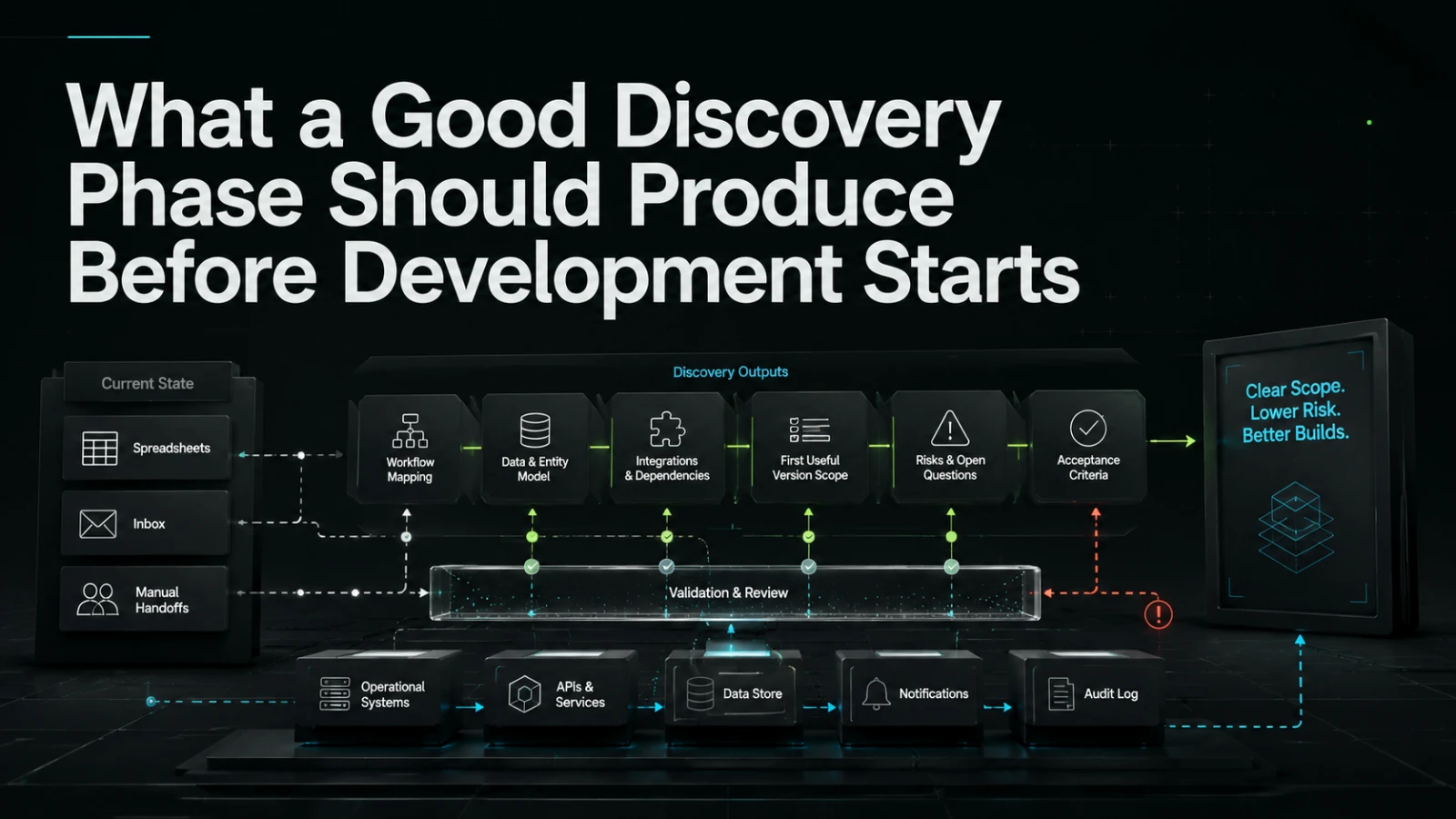
A discovery phase is not a polite delay before development. It is where the project becomes specific enough to build without guessing every important decision during implementation.
For founders, operators, product owners, and technical leads, the value of discovery is simple: it reduces expensive ambiguity. A good discovery phase should produce a shared understanding of the workflow, the users, the data, the integrations, the operational constraints, and the first useful version of the system. If it only produces workshop notes and a feature wish list, it has not gone far enough.
Discovery should produce decisions, not just documentation
Many software projects begin with statements that sound clear but are still too vague to build from:
“We need an internal dashboard.”
“We want to automate approvals.”
“We need a customer portal.”
“We need AI to help with intake.”
“Our spreadsheet process is getting too hard to manage.”
These may be valid business goals, but they are not yet implementation scope. Before development starts, the team needs to know what happens in the workflow, who owns each step, what data moves between systems, what exceptions occur, and what “done” means for the first release.
Discovery should turn broad intent into practical delivery shape. That does not mean every future feature must be specified. It means the first build should be clear enough that design, engineering, and business stakeholders are not inventing core rules mid-project.
A good discovery phase does not remove uncertainty. It separates uncertainty that must be resolved before development from uncertainty that can safely be handled later.
What teams usually get wrong
The most common mistake is treating discovery as a requirements collection exercise. Someone asks stakeholders what they want, writes down features, groups them into phases, and calls that a scope.
That misses the harder questions.
A feature list rarely explains why the workflow breaks, where handoffs fail, where data quality drops, or why a team keeps returning to spreadsheets even after buying software. It also does not show which parts of the process need automation and which parts still need human judgment.
Another mistake is skipping technical discovery because the project seems “simple.” Internal tools, automation systems, portals, and B2B platforms often depend on messy operational details: permissions, approval states, integrations, exports, notifications, audit trails, and edge cases. These details decide whether a system is dependable in daily use.
A rushed discovery phase often creates these problems later:
vague scope that expands during development
unclear ownership between client, product, and engineering teams
missing integration requirements
poor handling of exceptions and failed states
workflows that look good in a demo but do not match real operations
technical shortcuts that are hard to maintain after launch
no clear acceptance criteria for delivery
The core outputs of a useful discovery phase
A good discovery phase should produce a set of working assets, not just a document. The exact format depends on the project, but the outputs should make the future build easier to reason about.
Discovery output | What it should clarify | Why it matters before development |
|---|---|---|
Business problem definition | What pain the project is solving and why it matters now | Prevents building features that do not address the real operational issue |
Workflow map | How work moves today, including handoffs, approvals, exceptions, and delays | Shows where software can reduce manual effort or improve visibility |
User and role model | Who uses the system, what each role can see, change, approve, or export | Reduces permission gaps and unclear ownership |
Data and entity model | The main records, fields, statuses, relationships, and lifecycle states | Helps engineering design a system that reflects real operations |
Integration map | Which tools, APIs, imports, exports, emails, webhooks, or manual transfers are involved | Exposes technical risk early and prevents hidden dependency surprises |
First useful version scope | What must be included in the first release and what can wait | Keeps delivery focused and commercially realistic |
Acceptance criteria | How the team will know the first version works | Reduces subjective sign-off and rework |
Risk register | Open questions, technical unknowns, security concerns, and operational dependencies | Makes uncertainty visible before it affects delivery |
Delivery plan | Sequencing, milestones, responsibilities, and decision points | Helps stakeholders understand what must happen before launch |
These outputs do not need to become a heavy specification. For many projects, a concise scope document, workflow diagrams, a data outline, screen-level notes, and an implementation plan are enough. The important part is that they are specific, testable, and useful to the people who will build and operate the system.
Define the workflow before defining the screens
Screens are easier to imagine than workflows, so teams often jump straight into interface ideas. That can be useful, but it is risky when the workflow is still unclear.
For example, an approval dashboard may look simple. But before development starts, the team should know:
who can submit a request
what information is required at submission
which states the request can move through
who can approve, reject, comment, or reassign
what happens when data is incomplete
which notifications are required
what should be logged for audit purposes
which reports or exports are needed later
Without those answers, the interface becomes decoration around an undefined process. Engineering then has to infer business rules while building. That increases rework and can lead to a system that behaves inconsistently in production.
A stronger discovery phase starts with workflow state. What is new, pending, approved, rejected, blocked, completed, archived, or escalated? What moves an item from one state to another? Which transitions are automatic, and which require a person?
Once the workflow state is clear, screens become easier to design because they are supporting a known process.
Separate the first useful version from the full vision
Discovery should protect the long-term vision without forcing the first release to carry all of it.
A founder may have a product platform in mind. An operations team may want a full internal system. A business owner may want to replace several spreadsheets, inboxes, and manual reports. Those goals may be valid, but the first build should usually focus on the narrowest version that creates operational value and can be tested in real use.
A good first useful version often includes:
one core workflow
a limited set of user roles
the most important records and statuses
essential notifications or approvals
basic reporting or export needs
the integrations required for the workflow to function
enough admin control to avoid developer involvement in routine changes
What it should usually avoid:
secondary workflows that are not yet validated
complex dashboards before data quality is proven
deep automation for rare edge cases
advanced AI features before the underlying process is stable
integration work that can be safely handled later
excessive configuration before the operating model is clear
This is not about building something small for its own sake. It is about building something coherent. A narrow system that works inside the business is more useful than a broad system full of assumptions.
Identify what should not be automated yet
Discovery is also where the team should decide what stays manual.
This is especially important for AI-assisted workflows, internal tools, and operational automation. Not every repeated task should be automated immediately. Some steps may require human judgment, legal review, commercial negotiation, or exception handling that is not yet consistent enough to encode in software.
A practical discovery phase should ask:
Is this step repetitive and rule-based?
Does the team already agree on what a correct outcome looks like?
Are the inputs structured enough?
What happens when the automation is wrong?
Who reviews or overrides the result?
Is there an audit trail?
Can the business maintain this process after launch?
Automation works best when the workflow is understood. If the process is unstable, the first build may need to make work visible before it makes work automatic. For example, a system might first centralize intake, assign ownership, track status, and reduce duplicate entry. Later, once patterns are clear, it can automate routing, reminders, summaries, or data checks.
That sequencing can reduce implementation risk and help the team avoid automating a broken process.
Make integration risk visible early
Many B2B systems are not difficult because of the interface. They are difficult because they must connect to other systems, respect existing data, and fit into daily operations.
Discovery should identify:
which systems need to send or receive data
whether APIs are available and suitable
whether data will be synced, imported, exported, or manually reconciled
how often data needs to update
what happens when an integration fails
who owns credentials, access, and support
whether historical data must be migrated
which fields are required for reporting or compliance
Even a simple integration can affect scope if the source system has inconsistent data, limited API access, unclear ownership, or manual workarounds. These issues do not make the project impossible, but they should be visible before the delivery plan is agreed.
A dependable discovery phase does not hide integration uncertainty. It names it, sizes it, and decides how the first version should handle it.
Produce acceptance criteria that reduce subjective sign-off
One of the most valuable discovery outputs is clear acceptance criteria. These do not need to describe every pixel or every technical implementation detail. They should explain the conditions under which the first version is considered usable.
For an internal approval tool, acceptance criteria might include:
a user can submit a request with required fields
the correct approver is assigned based on defined rules
approvers can approve, reject, or request changes
users can see the current status of their own requests
operations can filter requests by state, owner, and date
key status changes are recorded
failed notifications or integration errors are visible to an admin
This gives business and technical teams a shared delivery target. It also protects the project from vague feedback such as “it does not feel finished” when the real issue is an unstated requirement.
Discovery should also define ownership after launch
A system is not finished when development ends. Someone must operate it, maintain it, adjust it, and decide what changes next.
Before development starts, discovery should clarify:
who owns business rules
who approves scope changes
who manages users and permissions
who receives support requests
who monitors errors or failed jobs
who decides what enters the next release
what content, configuration, or workflow settings the client team can manage themselves
This is where many internal tools and automation projects become fragile. The software may function, but nobody clearly owns the operational model. Over time, workarounds return, data quality declines, and the system becomes harder to trust.
Good discovery accounts for the post-launch reality. It should help the team build something that can be operated, not just delivered.
Where AI can help, and where it cannot replace judgment
AI-assisted tools can speed up parts of discovery: summarizing interviews, grouping requirements, drafting workflow variations, identifying repeated themes, or producing first-pass documentation. This can be useful when handled carefully.
But AI should not replace accountable product and technical judgment. It cannot decide the business priority, confirm operational ownership, validate integration constraints, or resolve trade-offs between cost, speed, maintainability, and risk. Those decisions need experienced people in the room.
For Aptenova, AI is useful when it reduces manual analysis and helps teams move faster toward clear scope. It is not a substitute for understanding the business process, the system boundaries, or the delivery risk.
When to talk to a software partner
A discovery phase is especially valuable when the project involves more than a simple website or isolated feature. It is worth involving a technical partner when:
the workflow spans multiple teams or departments
the current process depends on spreadsheets, inboxes, or manual approvals
several tools need to exchange data
the system needs different user roles or permissions
the first version must support future expansion
the team is unsure whether to automate, rebuild, integrate, or improve an existing system
technical risk is unclear but the business cost of delay is real
If this resembles a workflow inside your business, Aptenova can help turn the first useful version into a clear software scope.
Conclusion: discovery is the first delivery decision
A good discovery phase should produce clarity that changes how the project is built. It should define the problem, map the workflow, expose risks, shape the first useful version, and give business and technical teams a shared basis for delivery.
The output is not paperwork for its own sake. It is a practical tool for reducing rework, improving decision quality, and making the first build easier to implement, test, operate, and improve.
Before development starts, the team should not know everything. But it should know enough to stop guessing about the core workflow, the users, the data, the integrations, and the delivery target. That is the difference between starting a project with momentum and starting one with hidden risk.
Put it into practice
Working through a similar problem?
Tell us about your product and the change you need. We can discuss a focused feature, a new integration, an AI workflow or a first release.