DevCerts

A developer certification platform and a concrete example of Aptenova B2B software development. DevCerts keeps the path visible from public catalog to candidate workspace, paid voucher balance, launch-ready exam permit, Askium-powered exam delivery, submitted attempt, issued certificate, and public credential verification.

Vouchers

Candidates buy voucher balance first, then spend one voucher to prepare access for a selected certification.

Askium

The real exam runtime stays outside DevCerts; launches and results are connected through explicit integration contracts.

Proof

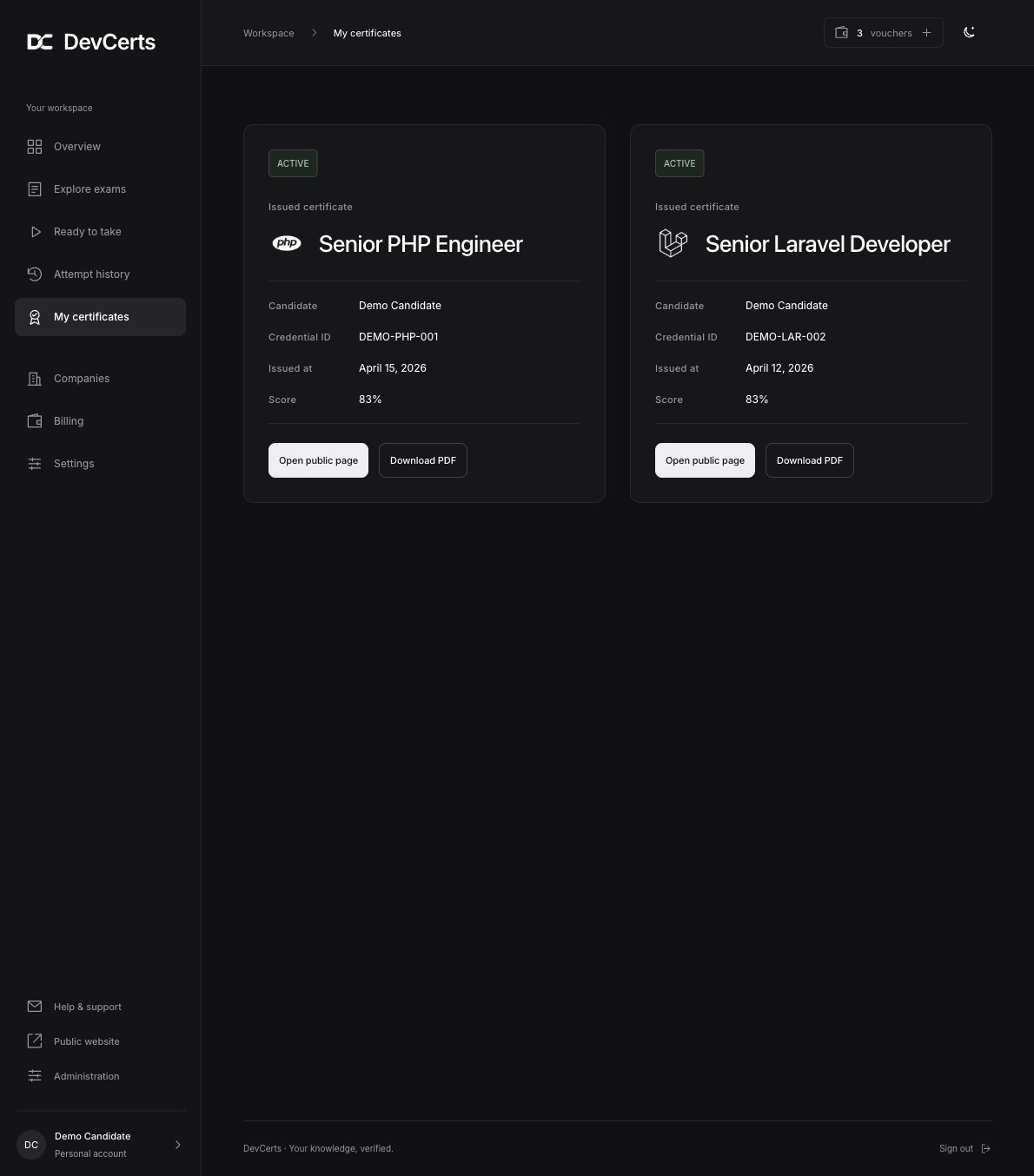
Passed attempts become public certificate records with status, issue data, credential IDs, and downloadable PDFs.

B2B platform development

One workflow for vouchers, exam access, attempts, certificates, and verification.

DevCerts is built around a clear boundary: it manages certification commerce, access, issuance, and proof, while the actual exam session and scoring are handled by Askium. It shows how Aptenova handles platform rules, payments, external services, identity, and public verification in one product.

01

Public pages explain the certification catalog, prices, exam rules, methodology, company use cases, legal policies, contact paths, and blog content without promising guaranteed outcomes.

02

Candidates register, buy vouchers, keep balance available, and convert one voucher into a launch-ready permit for a specific certification when they are ready to take it.

03

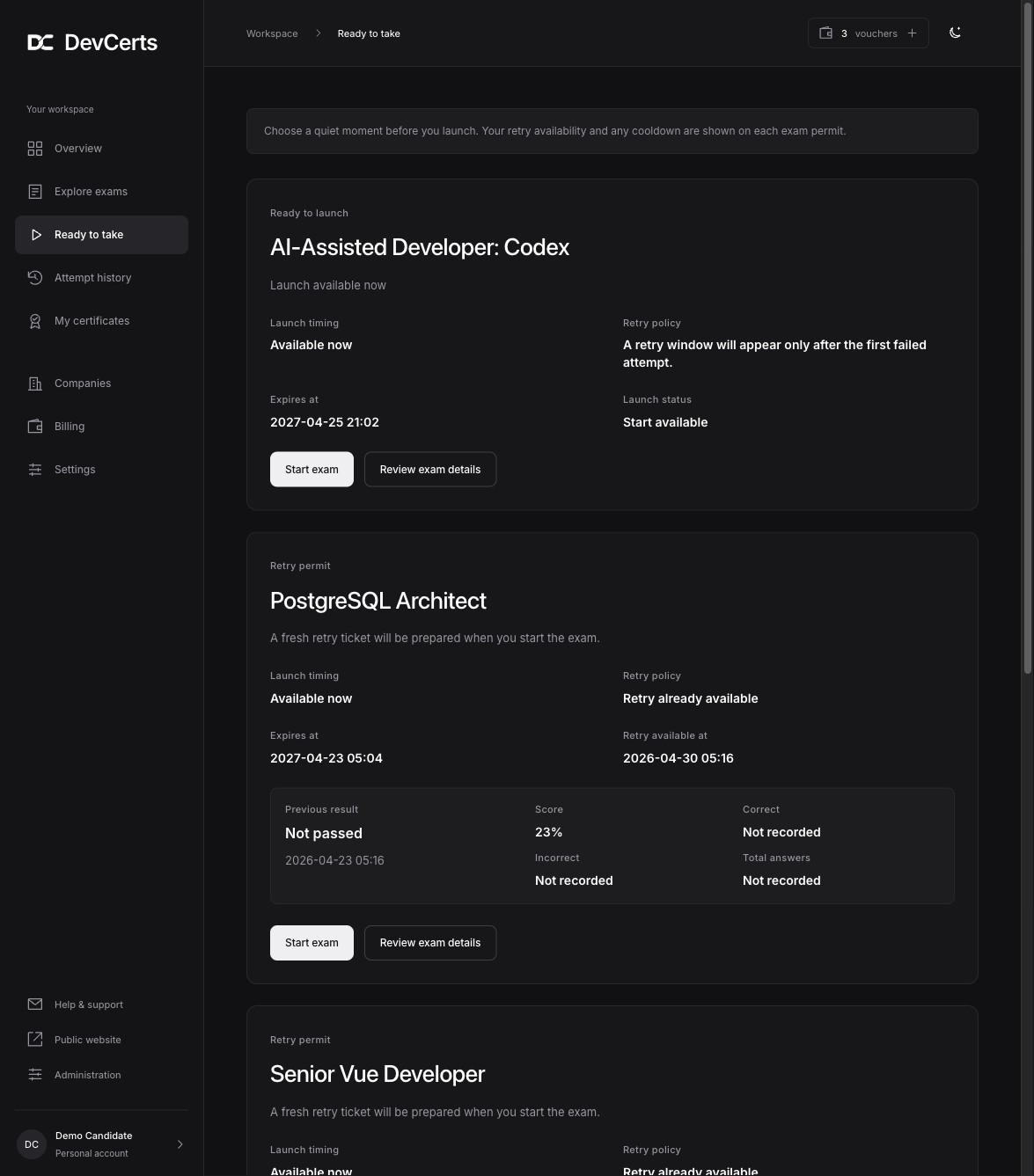
Exam permits orchestrate Askium launch links, validity windows, retry policy, cooldown rules, and the candidate-facing status around prepared or completed attempts.

04

Successful webhook-confirmed results issue certificate records with immutable candidate snapshots, score data, credential identifiers, public verification pages, and PDF output.

Key Features

What makes DevCerts useful as a development example.

The strongest part of the product is the connected certification lifecycle: catalog, payments, permits, external exam delivery, result intake, certificate issuance, and public verification all share one domain model.

  • Role-based certification catalog

    Certification pages keep technology labels, exam scope, preparation topics, SEO metadata, certificate wording, and catalog order separate enough to manage real offerings.

  • Voucher-backed exam access

    The product sells voucher balance, not guaranteed certificates. A voucher is spent only when a candidate prepares access for a specific certification exam.

  • Askium launch and result intake

    DevCerts prepares exam access, launches candidates into Askium, receives result webhooks, and derives passed or failed state from the configured score threshold.

  • Permit lifecycle and retry rules

    Exam permits track prepared, launch-ready, completed, expired, retry-ready, cooldown, and retry provisioning states without mixing them into payment records.

  • Public certificate verification

    Issued certificates expose public verification pages, credential IDs, status, issue dates, score summaries, downloadable PDFs, and verification-oriented sharing surfaces.

  • Signed proof and JWKS output

    Certificate proof payloads, signing keys, JWKS output, verification keys, comparison endpoints, and verification logs make public credential checks auditable.

  • Certificate PDF and share assets

    Credential pages can produce downloadable PDFs, public share images, QR codes, template-based certificate views, and share-oriented verification links.

  • Candidate and company workflows

    Candidate workspace flows cover voucher balance, ready-to-take exams, attempts, certificates, billing, profile identity, social sign-in links, and company-managed access.

  • Company voucher and permit operations

    Company owners manage members, role changes, voucher transfers, company wallet balance, company-funded exam permits, action logs, and member-linked credential access.

  • Payment provider and webhook intake

    Voucher purchase orders, provider switching, Stripe and Paddle webhook intake, payload sanitizers, payment operations, and ledger entries keep commerce state explicit.

  • Profile security and social identity

    Profile flows cover certificate identity fields, password changes, two-factor setup, recovery codes, social provider links, and active-user access enforcement.

  • Editorial SEO and public renders

    Blog articles, topics, static legal pages, certification landing pages, cached public renders, sitemap output, and IndexNow submissions support acquisition content.

  • Admin-managed operations

    Filament-backed administration supports certification exams, users, payments, vouchers, certificate records, runtime settings, blog content, and inbound support operations.

  • Operational health and audit history

    Business widgets, integration health checks, history snapshots, user action events, payment webhook events, and support conversations expose what happened after each state change.

Product screens

A gallery of the certification product surface.

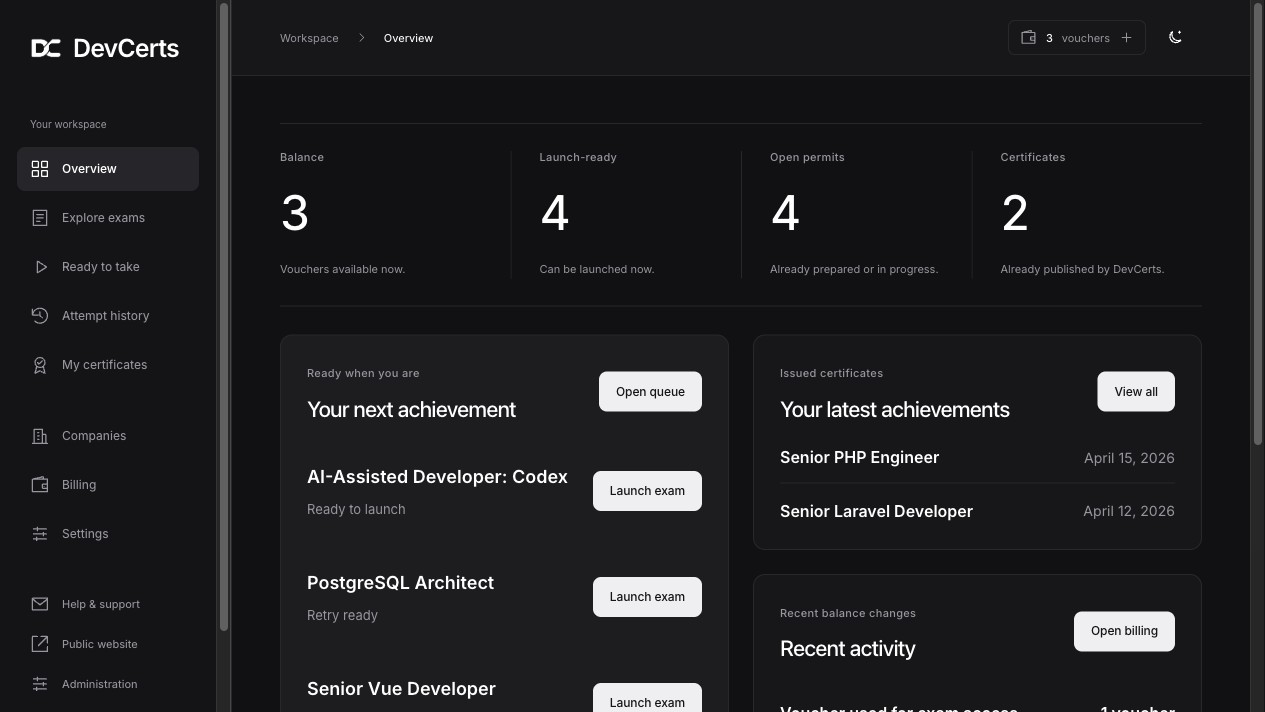
These screens come from the local DevCerts product: public positioning, candidate dashboard, certificates, permits, profile identity, and blog content.

Capabilities

The platform combines public acquisition, candidate operations, and credential proof.

01

Public surface: homepage, certification catalog, individual certification pages, prices, company information, exam rules, methodology, blog, contact, legal pages, sitemap, and robots output.

02

Candidate workspace: dashboard, voucher balance, buy-voucher flow, available exams, ready-to-take permits, attempts, certificates, billing, companies, profile identity, and two-factor setup.

03

Certification domain: voucher ledger, exam permits, retry windows, Askium launch orchestration, webhook result intake, certificate issuance, public verification, JWKS, and share-image output.

04

Operations layer: Filament admin resources, runtime settings, social provider toggles, payment provider switching, Mailjet-backed inbound support, blog management, and audit-oriented history tables.

Engineering roles

Laravel backend, Vue workspace, payments, webhooks, and certificate rendering.

DevCerts is not just a public marketing page for certificates. It is a product layer where payment-domain records, voucher accounting, external exam delivery, result validation, certificate templates, public verification, admin workflows, and editorial SEO all have to stay consistent: the same shape of complexity found in many custom B2B development projects.

Backend language

PHP

Backend runtime for certification catalog logic, voucher operations, launch orchestration, certificate issuance, and public verification flows.

Application framework

Laravel

Main framework for routing, authentication, payments, admin tooling, queues, webhooks, certificate rendering, and public pages.

Admin backoffice

Filament

Administration layer for certification exams, users, vouchers, permits, companies, payments, certificates, blog content, settings, and health widgets.

Database

PostgreSQL

Relational storage for users, vouchers, ledger entries, certification exams, permits, attempts, certificates, companies, payments, and blog content.

Cache and queues

Redis

Infrastructure layer for cache, background jobs, payment and mail workflows, and operational work that should not block user-facing screens.

Server-driven UI bridge

Inertia.js

Connects Laravel routes to Vue application screens for candidate workspace flows without a separate API-first frontend deployment.

Frontend interface

Vue.js

Interactive UI layer for dashboards, exam permits, profile settings, company access, voucher balance, and candidate certificate surfaces.

Workspace interaction language

JavaScript

Client-side language for candidate workspace interactions, voucher flows, profile and security screens, and public certificate surfaces.

Build pipeline

Vite

Frontend asset pipeline for the public site, authenticated workspace, admin-adjacent screens, and production bundles.

UI styling system

Tailwind CSS

Utility CSS system for public pages, certificate templates, candidate workspace screens, blog views, and dense operational UI.

Social authorization

OAuth 2.0

Authorization protocol behind social sign-in connections, profile identity linking, and provider-managed authentication flows.

Certificate render runtime

Node.js

Runtime used by the certificate PDF and share-image rendering toolchain through browser automation dependencies.

PDF and image rendering

Browsershot / Puppeteer

Headless browser rendering stack for certificate PDFs, preview HTML, public share images, and credential presentation assets.

Regression coverage

Pest / PHPUnit

Regression test stack for certification domain rules, payments, webhooks, candidate flows, public verification, and admin behavior.

Voucher-first access model

DevCerts separates payment from a specific exam by selling voucher balance first. The candidate spends one voucher only when preparing a permit for a concrete certification, and the system keeps ledger history around that movement.

External exam boundary

Askium owns question delivery, time limits, navigation, scoring, and result calculation. DevCerts owns catalog, permit state, launch orchestration, result intake, retry rules, and certificate issuance.

Verification as source of truth

Public certificate pages are the primary proof surface. PDFs are useful for sharing, but the live verification page carries the current credential status, issue data, result summary, and certificate identifiers.