Askium

A browser-based assessment platform and a concrete example of Aptenova SaaS platform development. Askium covers the full path from question set to reviewed result: creation, sharing, completion, analytics, exports, verification, integrations, team operations, and controlled exam workflows.

3 formats

Questionnaire, Quiz, and Exam modes cover feedback, scoring, and stricter assessment flows.

Integrations

API tokens, webhooks, LTI 1.1/1.3 launches, deep linking, and grade return connect Askium to external systems.

11 locales

The public and product interfaces support English, Russian, Ukrainian, Spanish, German, French, Italian, Croatian, Czech, Portuguese, and Polish.

Platform development

One workflow for questions, delivery, scoring, review, and integration.

Askium is built for teams that need more than a generic form page: HR assessments, education, LMS-connected tests, certification, customer feedback, branded surveys, and controlled online exams. It shows how Aptenova handles product complexity across public pages, authenticated workflows, integrations, and operational controls.

01

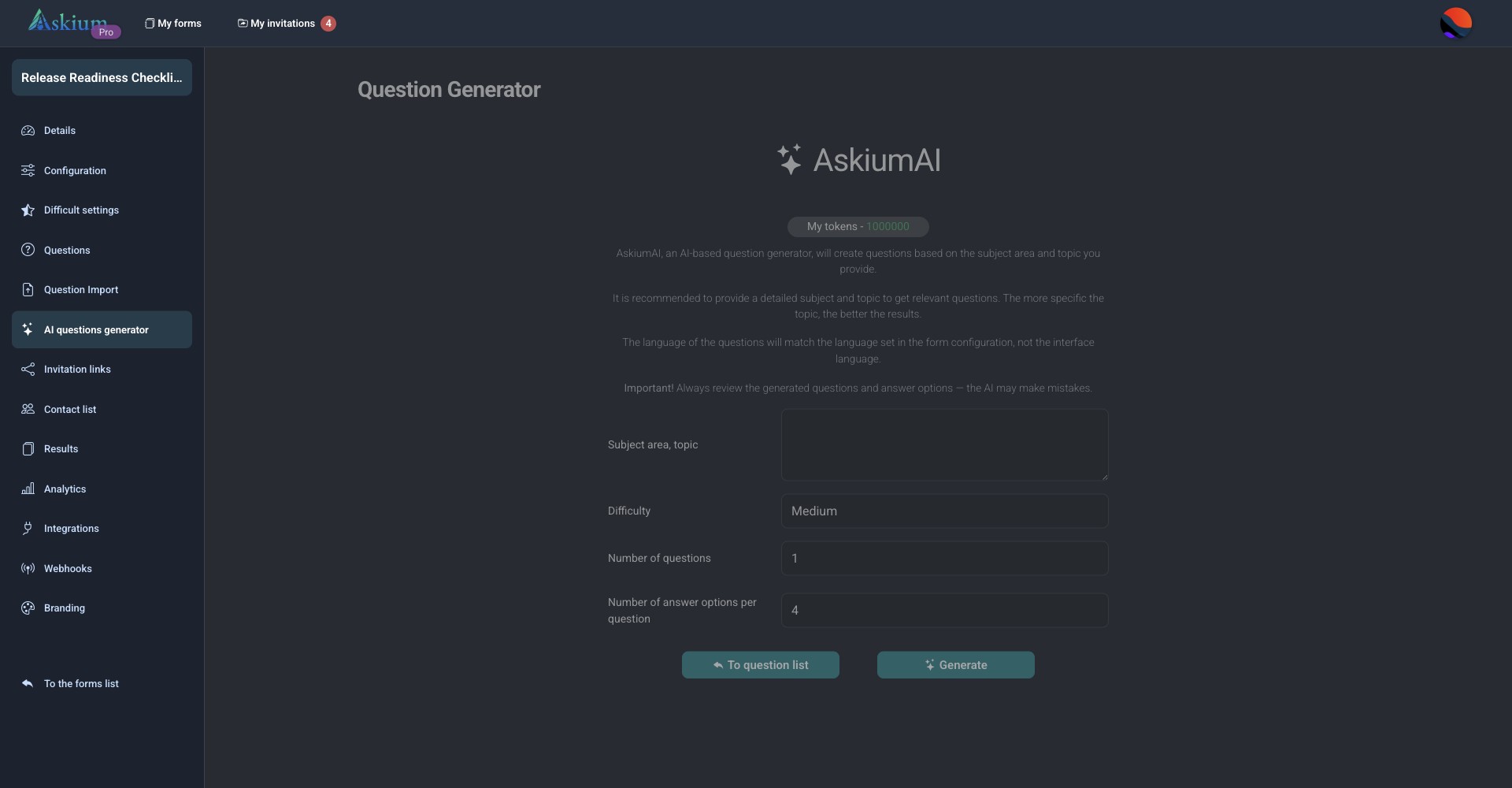
Create forms manually, import questions from JSON, or use AskiumAI to generate draft quiz and exam questions with answer options, difficulty, points, and form-language localization.

02

Publish a public form, create personal invitation links, generate QR codes, or launch through LMS flows. Exam mode uses personal tickets instead of anonymous public access.

03

Participants complete the flow on desktop or mobile with progress, timers, access rules, optional no-back behavior, event monitoring, and webcam proctoring signals when enabled.

04

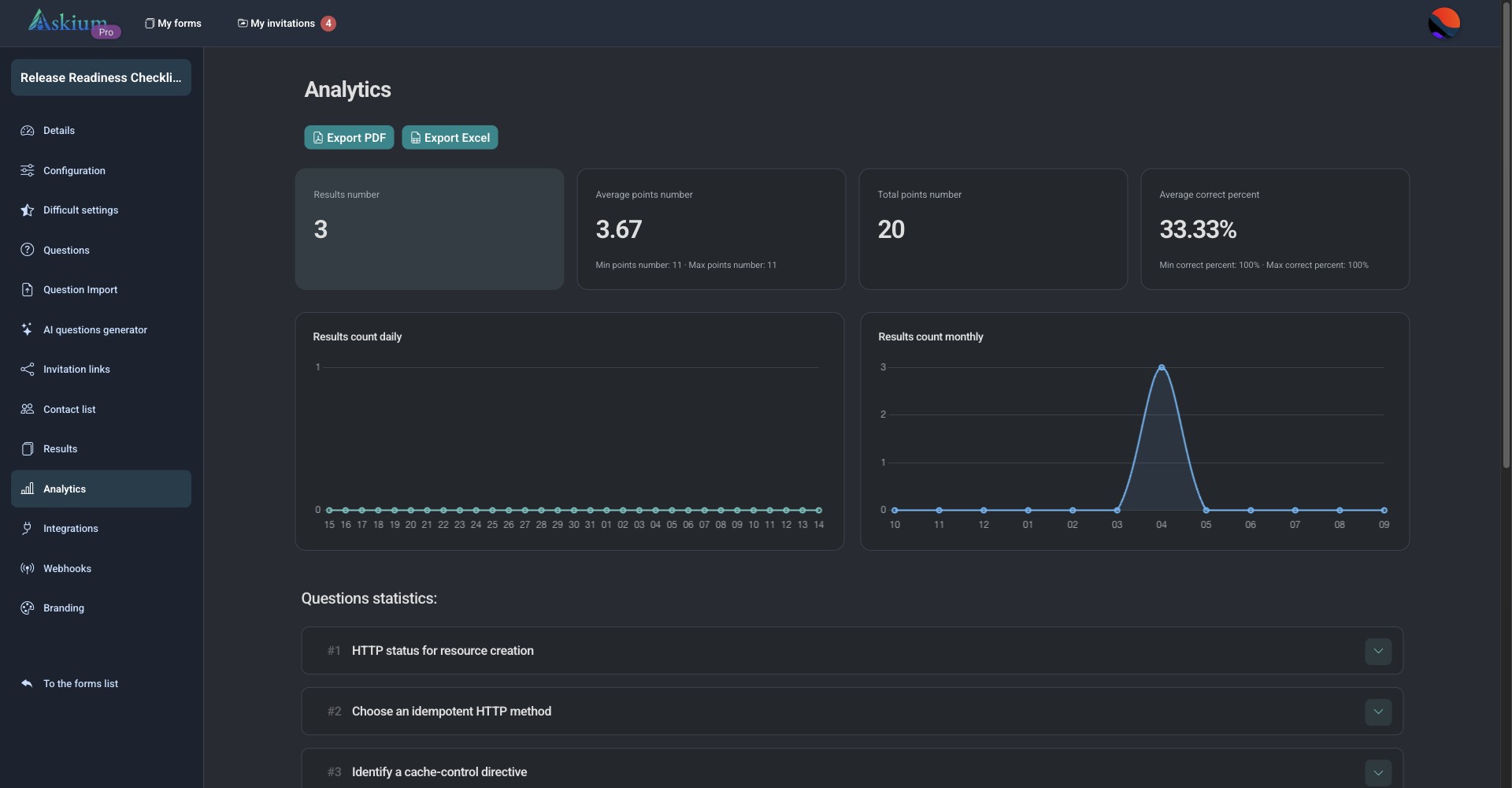
Owners review results, answers, scores, analytics, proctoring events, exports, result verification, and downstream delivery through API, webhooks, or LTI grade return.

Key Features

What makes Askium useful as a development example.

The product is strongest where simple form building turns into a controlled assessment workflow: AI-assisted creation, delivery controls, review tools, integrations, and team operations are part of one system.

  • Three assessment modes in one product

    Questionnaire, Quiz, and Exam workflows let the same platform handle feedback collection, scored tests, and stricter controlled attempts.

  • AI-assisted question generation

    AskiumAI creates reviewable draft questions and answer options from a topic, difficulty, answer count, points, and the form language.

  • Question builder and JSON imports

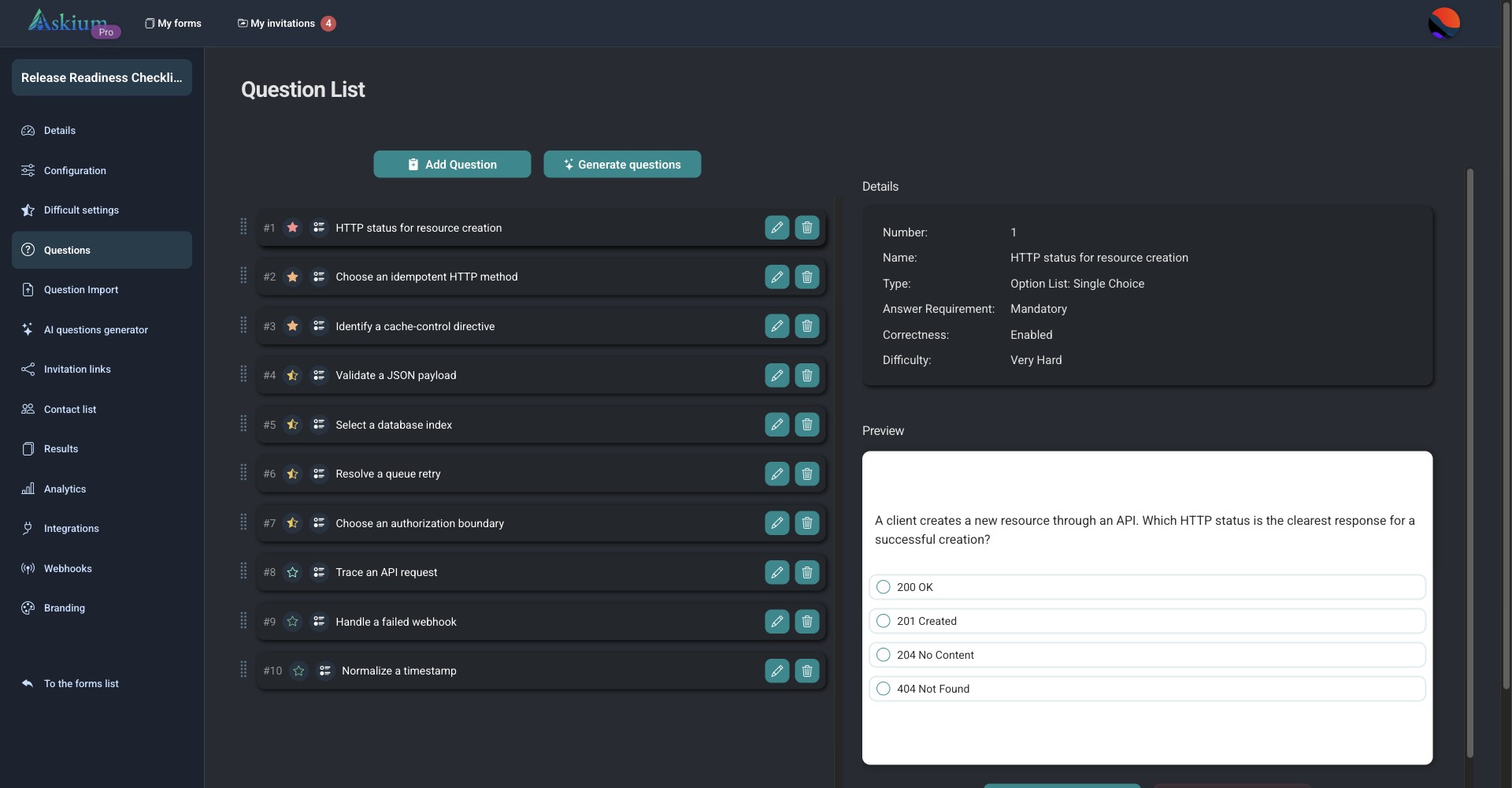
    Owners can build rich question sets with answer types, optionality rules, scoring, difficulty, images, pages, display conditions, and structured JSON import helpers.

  • Personal exam tickets

    Exam mode can generate unique invitation-only tickets from question pools with configured difficulty distribution and scoring rules.

  • Controlled delivery and proctoring signals

    Timers, no-back rules, action monitoring, webcam event signals, IP restrictions, and termination thresholds help reviewers inspect risky attempts.

  • Invitation, QR, and access controls

    Public links, personal invitations, QR codes, publication windows, password-like access boundaries, IP/CIDR restrictions, and per-link settings control entry into each assessment.

  • Branding and localized participant flows

    Logo, colors, fonts, button styles, branded result pages, reusable presets, and 11 product locales let assessments look owned instead of generic.

  • Analytics, exports, and verification

    Result review covers scores, answers, timing, correctness, analytics, PDF/XLSX exports, verification keys, and privacy-aware result handling.

  • API tokens and result webhooks

    Hashed API tokens, invitation-link endpoints, result verification APIs, configurable webhooks, delivery formats, auth headers, and retryable jobs support external workflows.

  • Deep integration surface

    API tokens, webhooks, OpenAPI/Postman assets, result verification, LTI 1.1, LTI 1.3, deep linking, and grade return support connected assessment workflows.

  • LTI 1.1 and LTI 1.3 LMS delivery

    Learning-platform integrations cover OIDC launch, deep linking, deployment keys, grade return, retry handling, line-item creation, and iframe-safe assessment launch.

  • Team and brand operations

    Workgroups, scoped permissions, branding presets, contact lists, exports, analytics, and subscription limits make Askium usable as an ongoing product, not a one-off form tool.

  • Queued exports and operational jobs

    Background jobs handle AI generation, question imports, PDF/XLSX exports, webhook delivery, expired attempts, scheduled publishing, balance refresh, and queue health checks.

  • Admin diagnostics and product controls

    Filament, Pulse, Telescope, business metrics, runtime commands, and admin resources give the owner visibility into health, configuration, usage, and support operations.

Product screens

A gallery of the real product surface.

These screens come from the live product and Askium product articles: form setup, AI generation, tickets, participant flow, results, branding, teams, and access controls.

Capabilities

The platform combines creation tools, participant delivery, and operational control.

01

Builder: question ordering, pages, display conditions, rich text, different answer types, file uploads, personal data fields, scoring, correctness, difficulty, and import helpers.

02

Exam controls: timed attempts, one-question-per-page flow, no-back rules, personalized tickets, activity monitoring, webcam proctoring event signals, IP access rules, and attempt termination thresholds.

03

Operations: workgroups, member permissions, contact lists, invitation email flows, subscriptions, usage limits, support categories, and admin-only diagnostics.

04

Integration layer: hashed API tokens, invitation-link API, result verification, webhook payloads, OpenAPI/Postman assets, LTI 1.1 cartridges, LTI 1.3 discovery, deep linking, and grade return.

Engineering roles

Laravel backend, Vue product app, queued workflows, and integrations.

Askium has the shape of a product platform: public pages, authenticated owner UI, participant flows, billing, exports, proctoring signals, API surfaces, LMS protocols, and background processing all have to behave as one system. That is the same engineering surface Aptenova brings to client software development work.

Backend language

PHP

Backend runtime for form configuration, assessment rules, subscriptions, integrations, exports, and queued product workflows.

Application framework

Laravel

Main framework for routing, auth, billing flows, jobs, scheduled tasks, API endpoints, webhooks, LTI, and admin tooling.

Admin backoffice

Filament

Operational backoffice for product configuration, users, subscriptions, content, diagnostics, and support-facing administration.

Database

PostgreSQL

Relational storage for users, forms, questions, answers, invitations, attempts, scores, workgroups, subscriptions, and integration records.

Cache and queues

Redis

Infrastructure layer for cache and queued work such as AI generation, exports, mail, webhooks, and integration tasks.

AI integration

OpenAI

AI integration for topic validation, question generation, answer-option drafting, usage logging, retry handling, and reviewable generated output.

Social authorization

OAuth 2.0

Authorization protocol used through social sign-in connections and identity flows without storing third-party passwords.

Server-driven UI bridge

Inertia.js

Connects Laravel routes to Vue application screens without turning the private product surface into a separate SPA deployment.

Frontend interface

Vue.js

Interactive interface for form setup, question editing, AI generation, tickets, analytics, branding, workgroups, and participant flows.

Client-side behavior

JavaScript

Client-side language for assessment builder interactions, participant flows, proctoring signals, and browser-side guard modules.

Build pipeline

Vite

Frontend asset pipeline for Vue screens, public pages, client assessment flows, and production bundles.

UI component layer

Bootstrap

Interface foundation used across public and product screens together with custom Sass and product-specific Vue components.

Rich text editing

Quill

Rich text editor layer for question content, descriptions, assessment instructions, and owner-managed formatted copy.

Route sharing

Ziggy

Shares Laravel route names with Vue screens so form, result, integration, and account actions stay tied to backend routing.

Regression coverage

PHPUnit

Regression test stack for backend rules, product workflows, public behavior, and browser-side JavaScript guard modules.

AI-assisted assessment creation

AskiumAI generates draft questions and answer options inside quiz and exam forms. The workflow keeps human review in place, follows the form language, supports difficulty context, and avoids charging full generation tokens when a topic cannot be processed.

Controlled exam delivery

Exam mode combines personal tickets, timers, activity monitoring, webcam event signals, IP restrictions, access windows, and result review without promising absolute cheating prevention.

Connected product workflows

Forms can hand off results through exports, webhooks, API endpoints, result verification, and LTI workflows, while workgroups and scoped permissions keep the owner-side process manageable.